ArtiTwinSplat: Interactable Digital Twin Reconstruction from RGB-D Videos
Master’s Thesis, CVG Lab ETH Zürich · arXiv
Tech stack
3D Gaussian Splatting · Nerfstudio · PyTorch · RGB-D reconstruction · Camera localization
Problem
Digital twins built with 3D Gaussian Splatting look photorealistic but are static: doors, drawers and other articulated parts can’t be moved. Robots need digital twins where they can interact with, and which can be built from ordinary RGB-D captures.
Overview
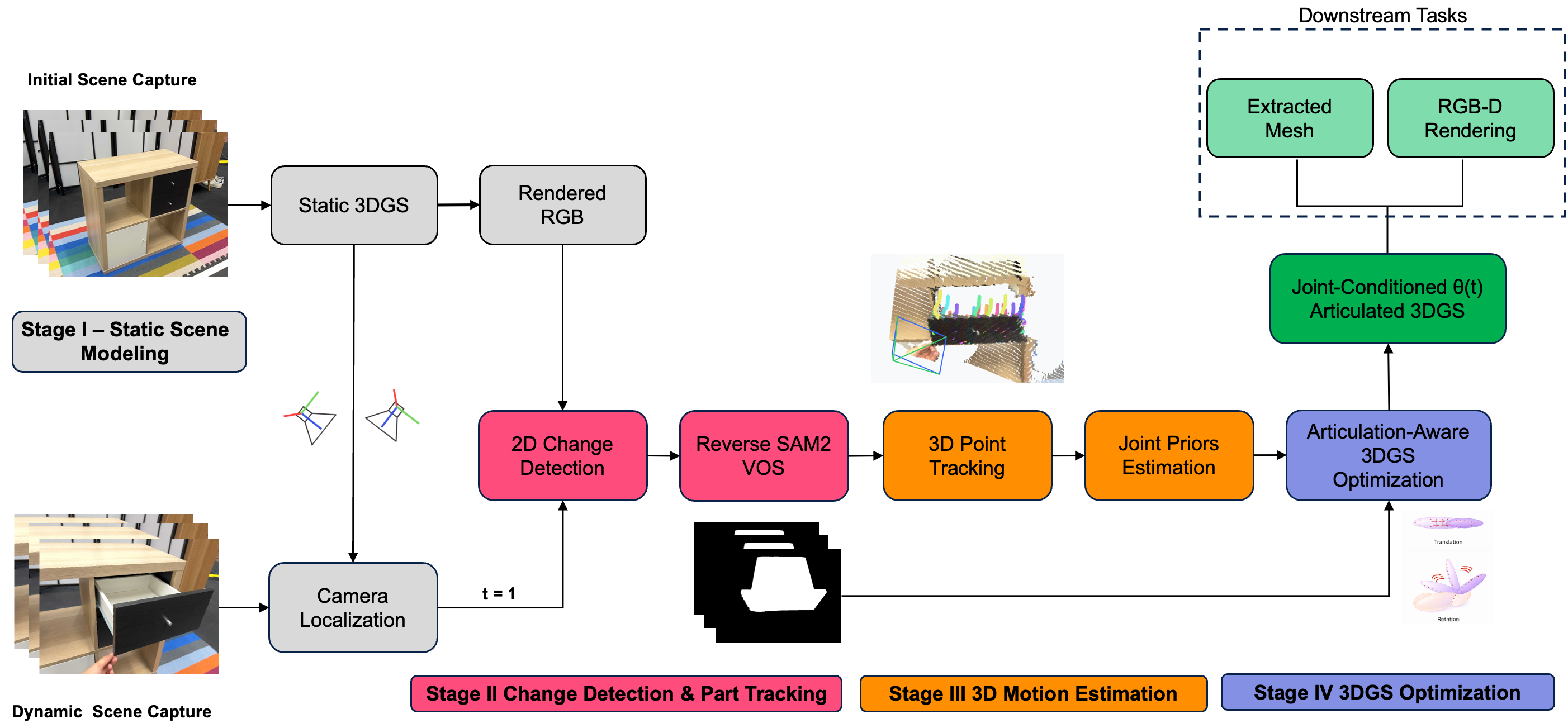
- A photorealistic, interactable 3D scene reconstruction pipeline based on 3D Gaussian Splatting (3DGS), extended to dynamic articulated scenes via disentangled background/object Gaussians.
- 4D RANSAC-based mobility fitting and an unsupervised RGB-D reconstruction framework to extract joint articulation priors for estimating object motion.
- An extension of Nerfstudio’s WebRTC-based viewer that renders dynamic, articulated Gaussian Splat scenes live, so the digital twin can be viewed remotely in real time.
Results
My role
Master’s thesis project and first author of the workshop paper.
Presented as a lightning talk and poster at the ICRA 2026 Workshop on AI-Driven Automation and Robotic System Integration with Digital Twins, Vienna.