
ROS 2 Real-Time Perception-to-Control for Non-Holonomic Wheelchairs
SCAI Lab, ETH Zürich · GitHub
Problem
A powered wheelchair moving through crowds has to perceive people around it and react to them in real time, on embedded hardware, while respecting non-holonomic kinematics: it can’t move sideways. Collision avoidance has to be safe for the occupant and still leave room for them to stay in control.
Overview
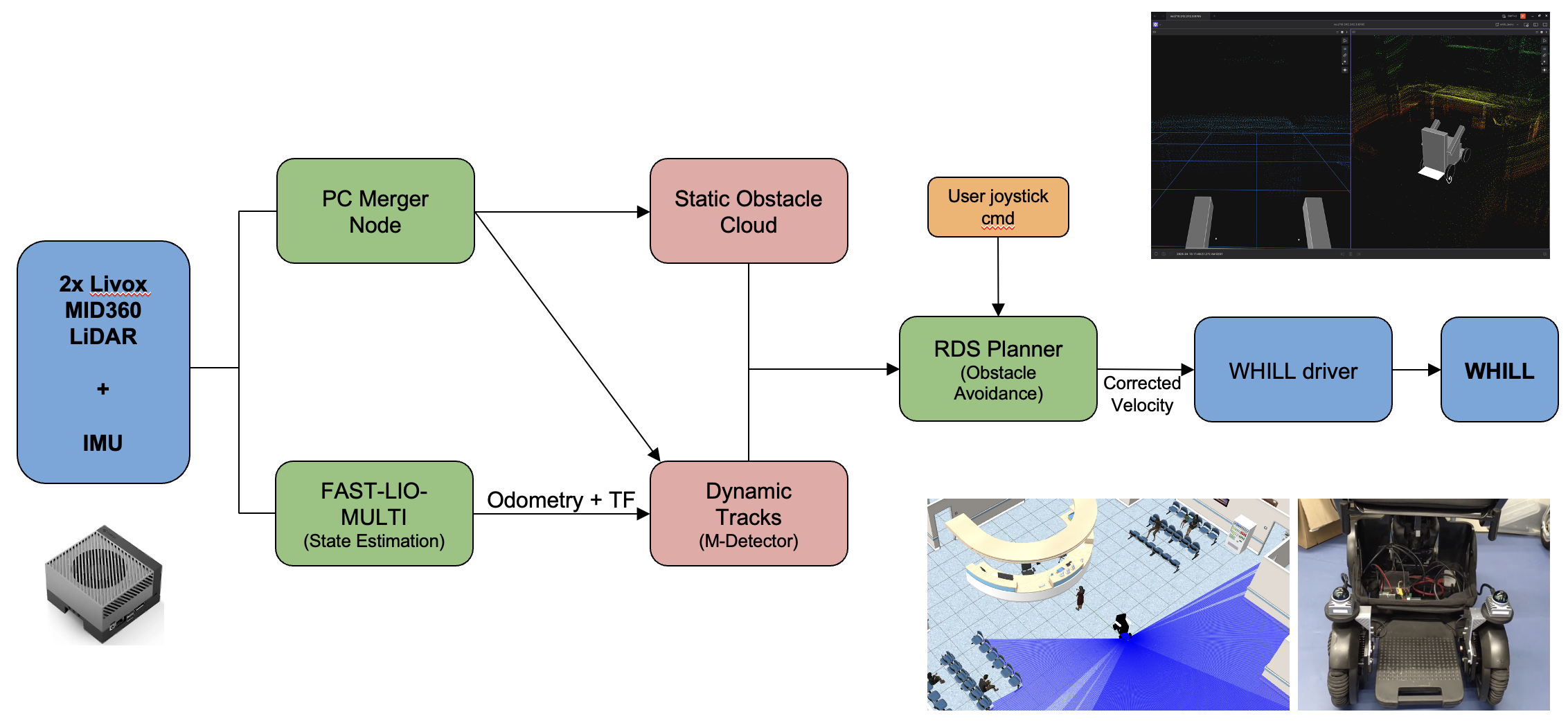
- Sensing: Two Livox MID-360 LiDARs (360°, built-in IMU) on a WHILL wheelchair with an NVIDIA Jetson.
- State estimation: FAST-LIO-MULTI fuses IMU and LiDAR data for real-time odometry.
- Point-cloud preprocessing: pc_utils converts, filters, and merges both LiDAR clouds into one obstacle cloud, removing the wheelchair’s body.
- Pedestrian detection: M-detector tracks moving agents (position, radius, velocity) from raw Livox data.
- Shared-control collision avoidance: RDS uses an RVO2-based planner to adjust joystick commands into the nearest collision-free velocity, published on /cmd_vel at ~10 Hz.
- Motor control: pywhill_ros sends /cmd_vel to the WHILL motors over serial, with systemd handling automatic startup.